MHB Winning Tennis with Probability 0.3 and 0.7

  • Thread starter Thread starter WMDhamnekar
  • Start date Start date
  • Tags Tags
    Tennis
Click For Summary
The probability of winning a tennis game from Deuce with a point-winning probability of 0.3 is approximately 15.51%. The analysis involves calculating the probabilities of winning and losing points, leading to a series of independent trials. A state transition probability matrix can be constructed with states including Deuce, Ad-In, Ad-Out, and Game, where Game is an absorbing state. The winning probability can also be derived using a formula that simplifies the calculations by considering two points played at a time. Overall, the discussions emphasize the mathematical modeling of tennis scoring probabilities.
WMDhamnekar
MHB
Messages
378
Reaction score
30
Hi,

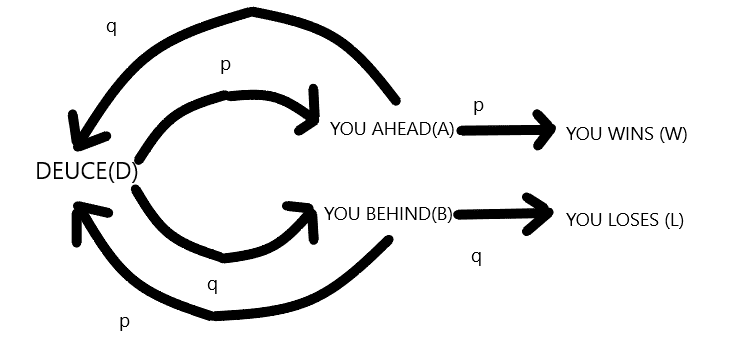
What is your probability of winning a game of tennis, starting from the even score Deuce (40-40), if your probability of winning each point is 0.3 and your opponent’s is 0.7?
1645684239650.png


My answer:
I think the sequence of independent trials are required to win a game of tennis starting from even score Deuce(40-40),each of which is a success with probability (0.3 × 0.3 =0.09) or a failure with probability (0.7 × 0.3 + 0.7 × 0.3 =0.42). Suppose, the independent trials to win a game of tennis are n. That means after (n-1) trials of failures, the nth trial is success.

$$ \displaystyle\sum_{n=0}^{\infty} 0.09 \cdot (0.42)^n =\lim_{n \to \infty}\frac{0.09\cdot ( 1 - 0.42^n)}{1- 0.42}= 0.15517 $$ = 15.51 %
 
Last edited:
Physics news on Phys.org
Have you worked out the states and the state transition probability matrix?
I see the states as
Deuce, Ad-In, Ad-Out, Game

with Game being an absorbing state.
 
Write out all the conditional probabilites P(W|X) where X = A, B, D. You will have a linear system of three unknowns and three equations, which can be solved by standard methods.

For example: If you are in state B, you must win the next point to have any chance of winning. If you lose the point you lose the game, so
P(W|B) = q P(W|D)
because if you do win the point (which you do with probability q), then you will be in state D and your probability of winning will be P(W|D).
 
There is a useful shortcut in considering two point played at a time. If the probability of winning a point is ##p##, then the probability of winning the game (##P##) satisfies:
$$P = p^2 + 2p(1-p)P$$Hence$$P = \frac{p^2}{2p^2 - 2p + 1}$$With ##p = 0.3##, this gives ##P \approx 0.155##.
 
  • Like
Likes DrClaude and Orodruin
PeroK said:
There is a useful shortcut in considering two point played at a time. If the probability of winning a point is ##p##, then the probability of winning the game (##P##) satisfies:
$$P = p^2 + 2p(1-p)P$$Hence$$P = \frac{p^2}{2p^2 - 2p + 1}$$With ##p = 0.3##, this gives ##P \approx 0.155##.
Other way of seeing this: Probability of winning in two points is ##p^2##. Probability of losing in two points is ##(1-p)^2 = 1-2p+p^2##. Probability of winning must therefore be
\[
\frac{p^2}{p^2 + (1-p)^2} = \frac{p^2}{2p(p-1) + 1}
\]
as otherwise we return to the same state.
 
  • Like
Likes DrClaude and PeroK
First trick I learned this one a long time ago and have used it to entertain and amuse young kids. Ask your friend to write down a three-digit number without showing it to you. Then ask him or her to rearrange the digits to form a new three-digit number. After that, write whichever is the larger number above the other number, and then subtract the smaller from the larger, making sure that you don't see any of the numbers. Then ask the young "victim" to tell you any two of the digits of the...

Similar threads

  • · Replies 10 ·
Replies
10
Views
2K
  • · Replies 1 ·
Replies
1
Views
2K
  • · Replies 7 ·
Replies
7
Views
2K
  • · Replies 8 ·
Replies
8
Views
3K
Replies
3
Views
2K
  • · Replies 3 ·
Replies
3
Views
1K
  • · Replies 10 ·
Replies
10
Views
2K
  • · Replies 1 ·
Replies
1
Views
2K
  • · Replies 2 ·
Replies
2
Views
2K
  • · Replies 1 ·
Replies
1
Views
2K